
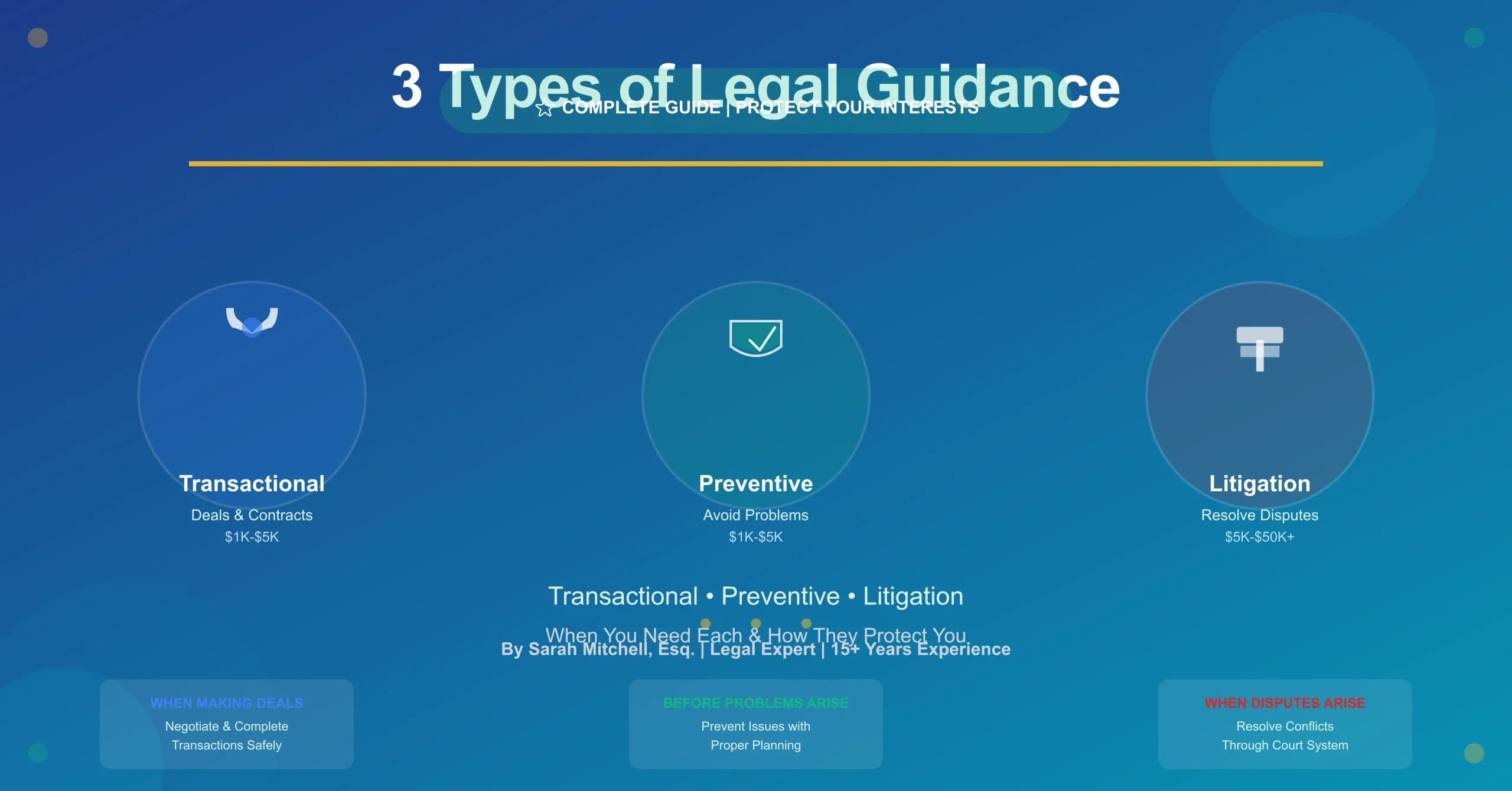
3 Types of Legal Guidance: Transactional, Preventive, Litigation
Throughout my 15 years of legal practice, I’ve observed that many people don’t realize there are fundamentally different types of legal guidance, each serving different purposes and occurring at different times in your legal journey. This misunderstanding often leads people to seek the wrong type of help for their situation, missing opportunities to protect themselves or spending money unnecessarily.
The law provides three primary types of legal guidance, each with distinct purposes, timings, and values. Understanding these three types empowers you to get the right help at the right time, optimize your outcomes, and often save significant money.
The Three Types of Legal Guidance
Transactional Law: Guidance when making significant legal transactions (buying property, signing contracts, starting businesses)
Preventive Law: Guidance to prevent problems before they occur (estate planning, contract review, policy development)
Litigation: Guidance when disputes arise and must be resolved through the legal system
Each type solves different problems at different times. Together, they form a complete legal protection strategy.
Type 1: Transactional Legal Guidance
What Transactional Law Covers
Transactional legal guidance assists you when you’re entering into significant legal transactions—deals that require formal agreements and have important legal implications. The attorney’s role is to ensure the transaction proceeds smoothly, fairly, and with protection for your interests.
Transactional matters include:
- Real estate transactions: Buying or selling property, handling title transfer
- Business formation: Creating partnerships, corporations, LLCs, and other business entities
- Contract negotiation: Major agreements with suppliers, customers, employers, landlords
- Mergers and acquisitions: Buying or selling businesses
- Financing agreements: Mortgages, loans, credit agreements
- Employment contracts: Executive agreements, non-competes, equity arrangements
- Technology/IP transfers: Licensing, sale of intellectual property
How Transactional Guidance Works
When you hire an attorney for transactional work, they:
1. Review all documents and terms
The attorney carefully reviews every contract, agreement, and document involved in the transaction to identify favorable and unfavorable terms.
2. Identify risks and implications
They analyze what could go wrong, what obligations you’re assuming, and what protections you need based on the law and transaction type.
3. Negotiate favorable terms
The attorney negotiates with the other party to modify terms in your favor, add protections, or remove unfavorable provisions.
4. Ensure compliance
They verify that the transaction complies with all applicable laws and regulations.
5. Complete the transaction properly
The attorney ensures all documents are properly drafted, executed, and filed so the transaction is legally valid and binding.
Why Transactional Guidance Matters
Poor transactional work can haunt you for years. Consider this real example:
📌 Real Example: The Unfavorable Contract
The Situation: A business owner signed a commercial lease without attorney review. The lease included a clause requiring the business to pay for all property maintenance, including structural repairs, even though the landlord was responsible.
The Problem: When the roof failed, the business owner was legally required to pay $50,000 for repairs—despite these being the landlord’s responsibility under standard property law.
The Cost: This one unfavorable lease clause cost $50,000, far exceeding what an attorney would have charged to review and negotiate the lease initially ($1,000-$3,000).
The Lesson: Transactional guidance prevents catastrophic financial mistakes that are locked in by contract language.
When to Seek Transactional Guidance
You Need Transactional Guidance When:
Cost of Transactional Guidance
Transactional work typically ranges from $1,000-$5,000 for simple transactions to $10,000+ for complex deals. This investment typically pays for itself by preventing unfavorable terms that could cost far more.
Type 2: Preventive Legal Guidance
What Preventive Law Covers
Preventive (also called “proactive”) legal guidance focuses on preventing problems before they occur. Rather than waiting for a dispute to arise, preventive guidance helps you establish proper structures, documentation, and policies that protect you from future legal issues.
Preventive legal matters include:
- Estate planning: Wills, trusts, powers of attorney to ensure your assets go where you want
- Contract templates: Creating standard agreements for your business to use repeatedly
- Liability protection: Structuring business entities to limit personal liability
- Compliance programs: Developing policies to ensure legal compliance
- HR policies: Creating employee handbooks and policies that prevent discrimination claims
- Document retention: Establishing systems for legal document management
- Insurance review: Ensuring you have adequate liability coverage
- Intellectual property protection: Registering trademarks, copyrights, patents
The Philosophy of Preventive Law
An ounce of prevention is worth a pound of cure. This principle drives preventive law. Consider the difference:
From My Experience: I recently worked with two clients in similar situations. One had proper estate planning in place; the other didn’t. When the first client passed away, her properly drafted trust allowed her assets to pass to her children quickly and tax-efficiently. The second client’s estate became embroiled in probate litigation that cost $80,000 and took three years to resolve. The difference? One spent $3,000 on estate planning; the other’s family spent $80,000 trying to fix the problem after the fact.
Real-World Impact of Preventive Guidance
📌 Real Example: The Preventive Contract
The Situation: A service business developed a standard contract for clients after getting preventive legal guidance. The contract included clear terms about scope, payment, dispute resolution, and liability limitations.
The Benefit: When a client later disputed the work quality and refused to pay, the contract clearly established the scope of work and payment terms, allowing the business to enforce collection without expensive litigation.
The Value: The contract cost $1,500 to develop but saved $20,000+ when the business could enforce it without going to court.
Preventive Law Statistics
Research supports the value of preventive law:
Proven Benefits of Preventive Legal Guidance
When to Seek Preventive Guidance
You Need Preventive Guidance When:
Cost of Preventive Guidance
Preventive work typically costs $1,000-$5,000, depending on complexity. This investment typically prevents disputes costing 5-20x more.
Type 3: Litigation Legal Guidance
What Litigation Covers
Litigation is legal guidance provided when disputes have arisen and must be resolved through the legal system. The attorney represents you in court, administrative hearings, or settlement negotiations aimed at resolving the dispute.
Litigation matters include:
The Litigation Process
When disputes require litigation, your attorney:
- 1. Assesses your case
- The attorney evaluates the strength of your position, potential outcomes, and risks.
- 2. Attempts settlement
- Often, cases settle before trial through negotiation, mediation, or arbitration.
- 3. Prepares for litigation
- If settlement fails, the attorney prepares evidence, files court documents, and develops trial strategy.
- 4. Conducts discovery
- Both parties exchange evidence and information relevant to the dispute.
- 5. Negotiates throughout
- Settlement negotiations continue throughout litigation as each side gains more information.
- 6. Represents you in trial or hearing
- If litigation proceeds to trial, your attorney represents you before a judge or jury.
Why Good Litigation Representation Matters
📌 Real Example: The Employment Dispute
The Situation: An employee was fired after requesting reasonable accommodations for a disability, as required by law.
Without Representation: Acting alone, the employee filed a complaint with the wrong agency, missed deadlines, and presented evidence poorly. The claim was dismissed on procedural grounds.
With Good Representation: An attorney would have filed with the correct agency, met all deadlines, and presented evidence effectively. The employee recovered $75,000 in back pay and damages.
The Difference: The attorney’s representation was worth $75,000+ because they knew the procedures and strategy.
When to Seek Litigation Guidance
You Need Litigation Guidance When:
Cost of Litigation Guidance
Litigation is typically the most expensive type of legal guidance, ranging from $5,000-$50,000+ depending on complexity and whether the case goes to trial. However, the stakes are often so high that the investment is necessary.
Comparing the Three Types
| Type | Purpose | When | Cost | Goal |
|---|---|---|---|---|
| Transactional | Complete major legal transactions safely | When making deals | $1,000-$5,000+ | Favorable terms & valid execution |
| Preventive | Prevent problems before they occur | Before problems arise | $1,000-$5,000 | Proper structure & documentation |
| Litigation | Resolve disputes through court system | When disputes arise | $5,000-$50,000+ | Win dispute or favorable settlement |
The Optimal Legal Strategy: All Three Working Together
The most successful legal strategy combines all three types of guidance at appropriate times:
The Complete Legal Strategy
- Step 1 – Preventive: Establish proper structures and documentation (estate planning, contracts, policies)
- Step 2 – Transactional: Get guidance when making major deals or changes
- Step 3 – Litigation: If disputes arise despite prevention, have proper representation
This approach prevents most problems, handles remaining ones with fair terms, and protects you if disputes still arise.
Real-World Example: Business Protection Strategy
How All Three Types Work Together
Year 1 – Preventive: New business owner gets preventive guidance to properly form the business (LLC for liability protection), create standard client contracts, and develop HR policies.
Year 3 – Transactional: Business owner gets guidance negotiating a lease for expansion space, ensuring favorable terms.
Year 5 – Litigation: When a client later claims inadequate work and sues, the proper contracts and documentation from preventive work enable the business to win or settle favorably.
The Outcome: Because of the complete strategy, the business protected itself at every stage, saved money overall, and had favorable outcomes when disputes did arise.
Conclusion
Understanding these three types of legal guidance empowers you to protect yourself at every stage of your legal journey. Transactional guidance helps you make deals safely. Preventive guidance helps you avoid problems altogether. Litigation guidance protects you if disputes arise despite your best efforts.
The most successful individuals and businesses don’t wait until problems arise—they build legal protection proactively through all three types of guidance when appropriate.