
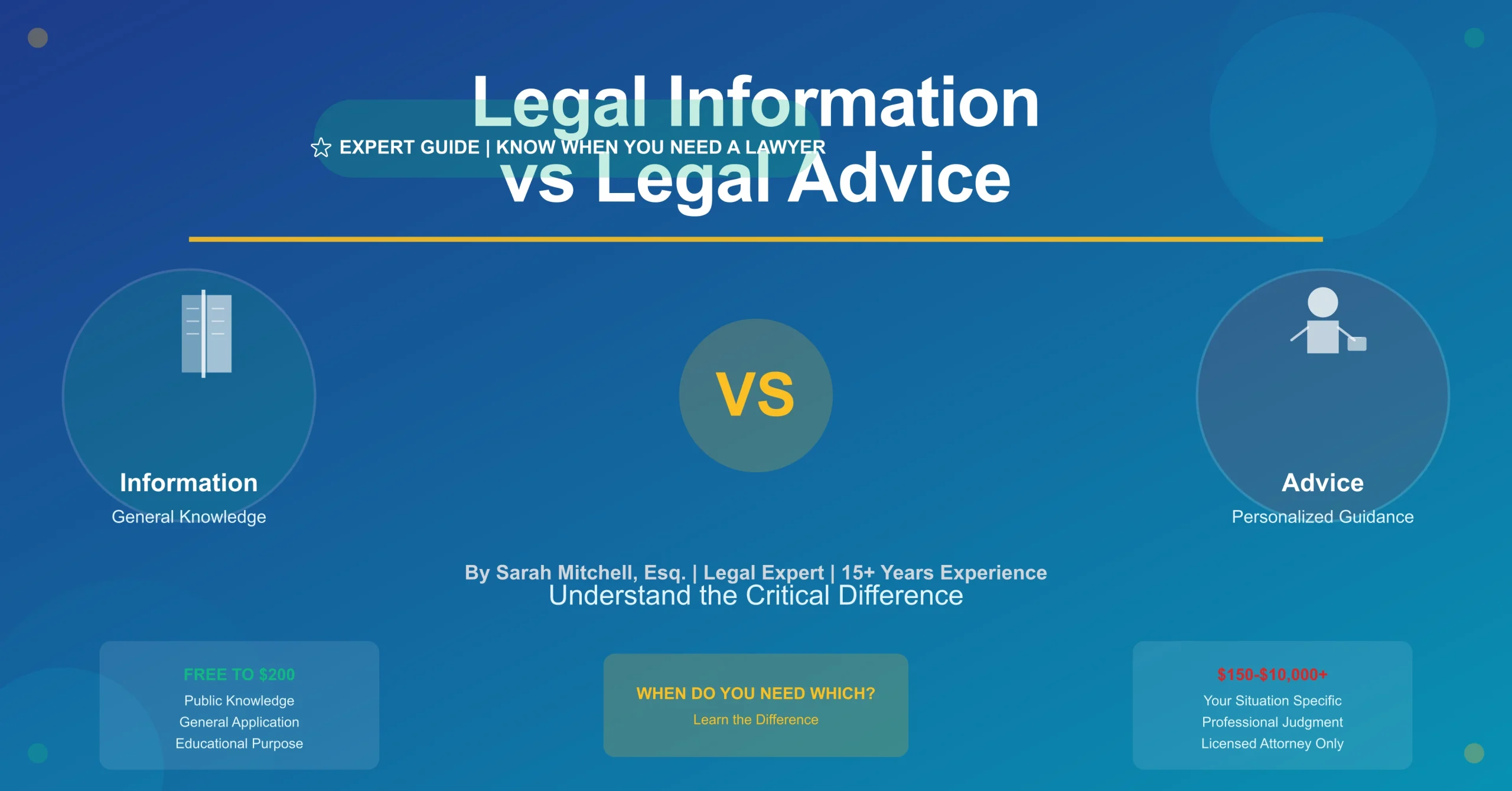
Legal Information vs Legal Advice: Know the Difference
In my 15 years of legal practice, I’ve encountered countless individuals who conflate two fundamentally different concepts: legal information and legal advice. This confusion has cost people thousands of dollars in unnecessary legal fees and, more troublingly, has resulted in poor decisions that harmed their legal positions.
The distinction between these two concepts is not merely academic—it’s practical, financial, and sometimes consequential for your rights and freedom. Understanding this difference empowers you to make informed decisions about when you need professional legal help and when educational resources suffice.
The Core Distinction
Legal Information is general, factual knowledge about how the law works that anyone can understand and use without personalized guidance.
Legal Advice is personalized, situation-specific guidance provided by a licensed attorney who analyzes your unique circumstances and recommends a course of action.
This guide provides legal information. Your attorney provides legal advice. Both have value, but they’re fundamentally different.
What is Legal Information?
Definition and Characteristics
Legal information is educational content about how the law works, what your rights are, what processes exist, and what outcomes typically occur in certain situations. It’s general knowledge that applies broadly to categories of people rather than to your specific circumstances.
Key characteristics of legal information include:
- General and factual: It describes the law as it exists, not how it applies to you specifically
- Publicly available: You can find it in law books, government websites, legal databases, educational articles, and this platform
- Applicable to many people: It addresses common situations that affect a broad audience
- Not personalized: It doesn’t take into account your unique facts, circumstances, or jurisdiction
- Educational: Its purpose is to teach, not to direct specific action
- No attorney-client relationship: Reading legal information doesn’t create a relationship with an attorney
Examples of Legal Information
Legal Information Example 1: Child Support Calculation
The Information: “Child support is typically calculated using each parent’s income, the number of children, custody arrangements, and state-specific guidelines. Most states use income shares models where both parents contribute proportionally to their incomes.”
Why it’s information: It explains the general process without addressing your specific income, state laws, or circumstances.
Legal Information Example 2: Tenant Rights
The Information: “Landlords must typically provide habitable premises, maintain essential services like water and heat, and give notice before entering rental units. Tenants generally have the right to withhold rent or repair-and-deduct for landlord violations, depending on state law.”
Why it’s information: It describes general tenant rights without analyzing whether your specific situation qualifies for these protections.
Legal Information Example 3: Divorce Property Division
The Information: “Property division in divorce depends on whether your state is ‘community property’ or ‘equitable distribution.’ Community property states divide marital property 50/50. Equitable distribution states divide property fairly, which may not be equal.”
Why it’s information: It explains the general framework without analyzing what counts as marital property in your situation or how judges would divide your specific assets.
Sources of Legal Information
You can access legal information through numerous sources:
Free Sources
Government websites, law school libraries, legal education platforms, legal blogs, bar association resources, Wikipedia (for basic concepts)
Paid Resources
Legal research databases (LexisNexis, Westlaw), legal education courses, self-help legal book kits, online legal document services
Paid Resources
Legal research databases (LexisNexis, Westlaw), legal education courses, self-help legal book kits, online legal document services
What is Legal Advice?
Definition and Characteristics
Legal advice is personalized guidance from a licensed attorney who, after analyzing your specific facts and circumstances, recommends a particular course of action. It applies the law to your situation, taking into account your unique circumstances, local jurisdiction, and desired outcomes.
Key characteristics of legal advice include:
- Situation-specific: It addresses your particular facts and circumstances
- Personalized: It considers your goals, risks, and options
- From a licensed attorney: Only attorneys licensed in your jurisdiction can provide legal advice
- Professional judgment: It involves the attorney’s experience, expertise, and professional judgment
- Confidential: Protected by attorney-client privilege
- Creates attorney-client relationship: Establishing that the attorney is your representative
- Directive: It typically recommends a specific action or approach
Examples of Legal Advice
Legal Advice Example 1: Your Child Support Situation
The Advice: “Based on your income of $60,000, your ex’s income of $75,000, having one child with 50/50 custody, and in our state’s income shares model, you should expect to pay approximately $450/month. However, I recommend proposing a slightly higher amount ($500/month) to demonstrate good faith, which may help in future disputes and make the judge view you more favorably if modifications are needed.”
Why it’s advice: It applies the law to your specific numbers, analyzes your situation, considers your relationship dynamics, and recommends a strategic approach.
Legal Advice Example 2: Your Tenant Rights Situation
The Advice: “Your landlord’s failure to maintain heat meets the standards for ‘breach of habitability’ in our jurisdiction. However, before exercising your right to repair-and-deduct, I recommend documenting everything with photos, sending a certified letter giving 14 days to cure, and consulting me again before taking action. This protects you if the landlord retaliates, which is illegal here but requires documentation to prove.”
Why it’s advice: It analyzes your specific situation, recommends a particular strategy, considers timing and documentation, and anticipates potential complications.
Legal Advice Example 3: Your Divorce Situation
The Advice: “Your spouse is claiming the house increase in value from $400,000 to $550,000 is community property. I disagree. The $400,000 was your separate property at marriage, and while you both lived there, you made $100,000 in improvements funded from joint income. Under our state’s law, you should receive the original value ($400,000) as separate property, and we should argue for at least 60% of the appreciation ($60,000) given your separate property contribution. I recommend we counter-offer at 70% and settle at 60%.”
Why it’s advice: It takes your specific facts, applies jurisdiction-specific law, analyzes the legal positions of both sides, and recommends a negotiation strategy.
Side-by-Side Comparison
Legal Information vs Legal Advice
| Aspect | Legal Information | Legal Advice |
|---|---|---|
| Scope | General, applicable to many | Specific to your situation |
| Source | Anyone with knowledge | Licensed attorney only |
| Personalization | Not personalized | Highly personalized |
| Cost | Free to low cost | $150-$400+ per hour |
| Confidentiality | Not confidential | Protected by privilege |
| Relationship | No relationship created | Attorney-client relationship |
| Example | “Divorce involves property division” | “You should propose this settlement” |
| Risk Level | Low (general knowledge) | High (can affect legal rights) |
When to Use Legal Information
Legal information is valuable and appropriate in many situations:
Use Legal Information When:
- Building foundational understanding of a legal area affecting you
- Learning what questions to ask an attorney
- Understanding your basic rights and protections
- Researching whether you need professional help
- Preparing for a consultation with an attorney
- Understanding legal processes and procedures
- Learning about different types of legal help available
- Gathering general information before making a decision
- Simple matters with clear answers (like understanding what documents you need)
Legal information provides the foundation that allows you to make informed decisions about whether you need professional advice.
When to Use Legal Advice
Legal advice is necessary when your situation is complex, high-stakes, or requires application of law to specific facts:
Use Legal Advice When:
From My Experience: The most costly legal mistakes I’ve seen involve people who tried to handle legal-advice-level situations using only legal information. They understood the general rules but misapplied them to their specific situation, missed critical nuances, or failed to anticipate how the other party would respond. Legal information creates a foundation; legal advice applies that foundation to reality.
The Risks of Confusion
Mistaking Legal Information for Legal Advice
The most common—and costly—mistake is assuming that understanding legal information means you can handle your situation without professional advice.
⚠️ Real Cost of This Mistake
A client came to me after trying to handle a custody dispute armed with general legal information about custody law. She understood that courts consider “best interest of the child” and thought she could present her case effectively. However, she didn’t understand that in our state, there’s a presumption favoring parents over other family members, that her proposed schedule was legally impractical given school calendars, and that she needed specific documentation to overcome the other parent’s claims. She lost custody of her children and spent $30,000 in legal fees trying to reverse the decision—far more than it would have cost to get advice initially.
Mistaking Legal Advice for Legal Information
The inverse problem—overpaying for advice when information would suffice—is less risky but still wasteful:
Cost Without Benefit
A client paid me $500 for a consultation to ask about standard lease terms, which is information available in any legal guide or template. While the consultation provided reassurance, it didn’t require my professional judgment. They could have spent $30 on a self-help book or gotten a free consultation with a legal aid clinic.
The Cost Difference
Understanding the difference also helps you budget appropriately for legal help:
Legal Information Costs
Free: Government websites, bar associations, nonprofits, law school clinics
Low ($0-50): Legal information guides, articles, educational materials
Moderate ($50-200): Legal document templates, online resources, educational courses
Legal Advice Costs
Consultation: $200-$400+ per hour (often 30 min to 1 hour)
Simple matters: $500-$2,000 flat fee
Moderate complexity: $2,000-$10,000+
High complexity: $10,000+ (litigation, complex transactions)
Combined Approach (Most Effective)
1. Use free/low-cost information to understand basics
2. Get professional advice on complex/high-stakes issues
3. Use information to understand advice and make better decisions
How Attorneys Provide Legal Advice
To clarify what “legal advice” entails, here’s how attorneys actually work:
The Consultation Process
- Gathering Facts: The attorney asks detailed questions about your situation, documents, timeline, and goals
- Legal Research: The attorney researches the applicable law in your jurisdiction
- Analysis: The attorney analyzes how the law applies to your facts
- Risk Assessment: The attorney identifies potential problems and risks
- Recommendations: The attorney recommends a course of action based on this analysis
- Implementation: The attorney helps implement the recommendation
This process—analyzing your specific facts through the lens of applicable law—is what distinguishes legal advice from information.
The Attorney-Client Relationship
When you receive legal advice from an attorney, you’re entering into a professional relationship with important consequences:
Key Consequences of Attorney-Client Relationship
- Confidentiality: Communications are privileged and can’t be disclosed without your permission
- Representation: The attorney represents your interests, not the other party’s
- Professional standards: The attorney must follow ethical rules and professional standards
- Accountability: The attorney can be disciplined or sued for malpractice
- Conflict checking: The attorney must ensure they don’t represent conflicting interests
Real-World Scenario: Knowing the Difference
The Same Situation: Information vs Advice
Situation: You receive a notice from your employer that you’re being terminated after requesting accommodations for a disability.
Using Legal Information:
“I read that employers can’t discriminate based on disability under the ADA. This seems like discrimination. I’ll document everything and send a letter to my employer explaining the law.”
Problem: You don’t know that your employer might have legitimate reasons for the termination unrelated to disability. You don’t know the specific ADA procedures, timing requirements, or whether you’ve followed the required steps. Your letter might actually hurt your position by appearing combative.
Using Legal Advice:
“Based on your facts—that you made a reasonable accommodation request, were performing your job adequately, and were terminated shortly after—this does appear to raise ADA concerns. However, before taking action, we need to: (1) Verify we have documentation of your request; (2) Check if we’re within filing deadlines; (3) Determine if informal resolution is possible before filing a complaint; (4) Understand what outcomes are realistic given your damages.”
Value of Advice: The attorney applies the law to your facts, understands the procedures, anticipates complications, and recommends a strategic approach. This can mean the difference between a successful claim and one that’s dismissed on procedural grounds.