
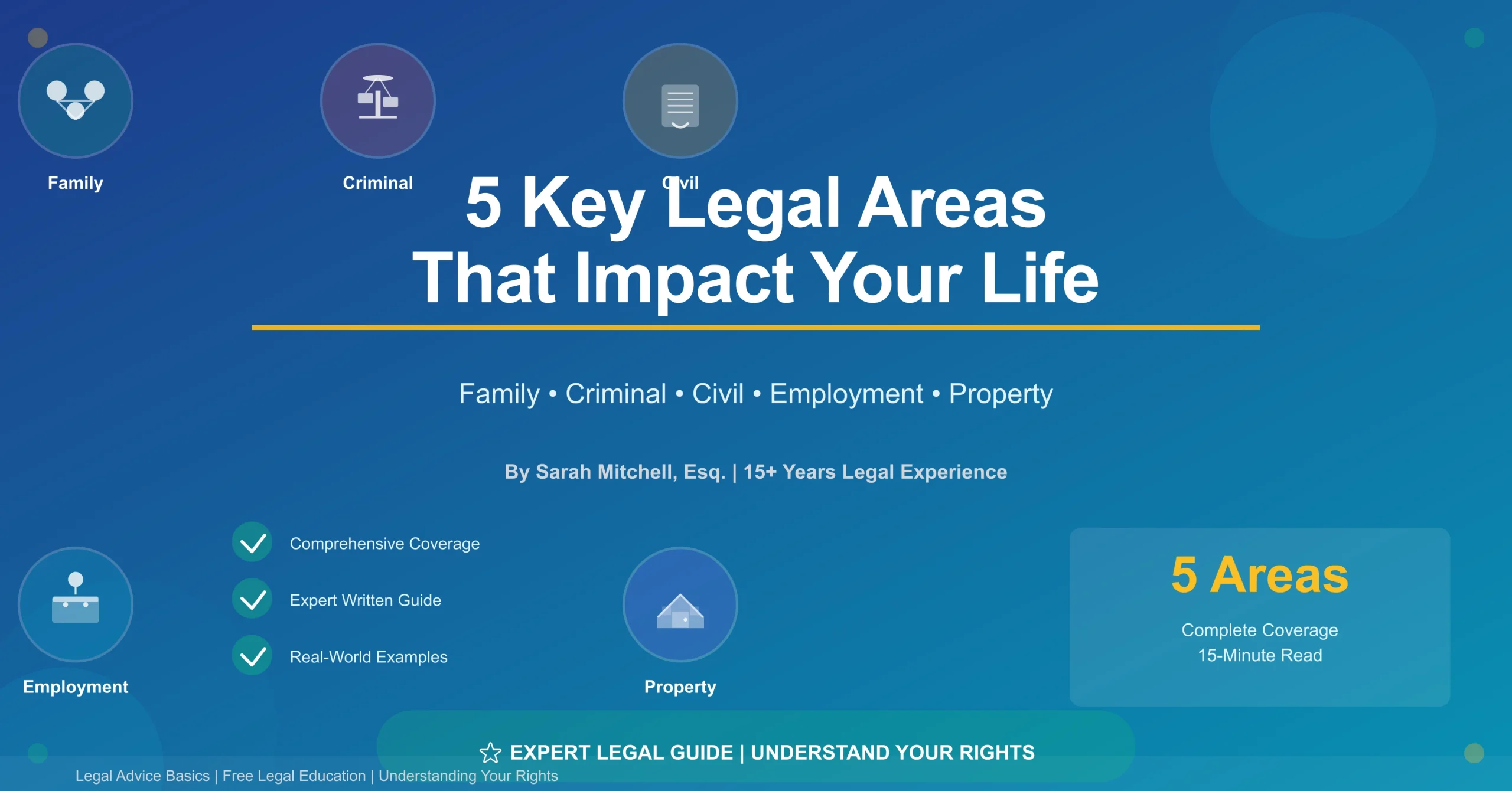
5 Key Areas of Law That Impact Everyday Life
Throughout my 15 years of legal practice, I’ve observed that most people don’t struggle with legal concepts because they’re unintelligent. Rather, they struggle because they don’t know which type of law applies to their situation. This foundational understanding is crucial.
The law isn’t a monolithic system—it’s divided into distinct areas, each with its own rules, procedures, and expertise requirements. Understanding these five key areas will help you identify your legal issues, know when to seek professional help, and navigate the legal system with confidence.
Understanding Legal Areas: The Foundation
Before we dive into each specific area, it’s important to understand why laws are divided this way. The legal system categorizes law by:
This organization helps ensure that people facing legal issues can find attorneys with relevant expertise and understand what to expect in their legal journey.
Family Law: Relationships and Dependents
What Family Law Covers
Family law governs the legal relationships between family members. This includes marriage, divorce, custody, child support, adoption, and inheritance. It addresses both the formation of family relationships and their dissolution or modification.
Specific areas within family law include:
- Marriage and divorce: Formation, termination, and property division
- Child custody and support: Parental rights, custody arrangements, and financial obligations
- Adoption: Legal processes for establishing parent-child relationships
- Domestic violence: Protective orders and legal remedies
- Spousal support/alimony: Financial support between spouses
- Inheritance and guardianship: Estate planning and child guardianship
Why Family Law Matters
Family law issues are deeply personal and emotionally complex. They affect your most important relationships and, in the case of children, their entire futures. The decisions made in family law cases impact:
Critical Life Areas
Expert Perspective: I’ve seen divorce settlements vary wildly based on whether people understood their rights. One client received 40% less in the property division simply because they didn’t understand the difference between marital and separate property. Another client unknowingly agreed to child support obligations that changed their entire financial future. Family law knowledge isn’t just helpful—it’s crucial for protecting your future.
When to Seek Professional Help
While simple uncontested divorces with no children might be handled without a lawyer, most family law matters benefit from professional guidance:
- ✓ Before initiating divorce or separation
- ✓ When children’s custody or support is involved
- ✓ When significant assets are at stake
- ✓ When domestic violence is involved
- ✓ When negotiating custody arrangements
- ✓ When modifying existing family law orders
📌 Real Example: The Custody Question
The Situation: A divorced father wanted to understand his custody rights and what factors courts consider when determining custody arrangements.
The Knowledge Gap: Without understanding family law, he might assume mothers automatically receive custody or that his financial situation would prevent him from getting equal custody.
The Reality: Modern custody law focuses on the “best interest of the child” without automatic preference for mothers. His financial situation is only one factor among many. Understanding this allowed him to advocate effectively for 50/50 custody.
Criminal Law: Rights and Freedoms
What Criminal Law Covers
Criminal law addresses violations against society, prosecuted by the government (state or federal). A criminal case involves the government as the plaintiff prosecuting an individual accused of a crime. The key distinction: in criminal law, it’s the People (represented by prosecutors) versus the accused, not between two private parties.
Criminal law covers offenses including:
- Felonies: Serious crimes like homicide, assault, theft, drug trafficking, sexual assault
- Misdemeanors: Less serious crimes like simple assault, petty theft, disorderly conduct, DUI
- Traffic violations: Speeding, reckless driving, driving with suspended license
- White-collar crimes: Fraud, embezzlement, tax evasion, insider trading
- Drug offenses: Possession, distribution, manufacturing controlled substances
Why Criminal Law Matters
Criminal law carries the highest stakes of any legal area: your freedom. A criminal conviction can result in imprisonment, permanently damage your employment prospects, restrict your rights, and fundamentally alter your life’s trajectory.
What’s at Stake in Criminal Cases
Your Rights in Criminal Proceedings
The United States Constitution provides extensive protections in criminal cases, including:
Constitutional Protections
When to Seek Professional Help
Criminal law is one area where you should almost always consult an attorney, even if you haven’t been charged yet:
- ✓ Immediately if arrested or accused of a crime
- ✓ If police want to question you
- ✓ Before accepting any plea deal
- ✓ If you’re considering confessing
- ✓ If facing any felony charge
⚠️ Critical Point: Always Exercise Your Rights
If arrested or questioned by police, immediately state clearly: “I want to speak to an attorney.” Do not answer questions without your lawyer present, even if you’re innocent. Anything you say can and will be used against you in court. This is not about guilt or innocence—it’s about protecting your rights.
Real Example: The Power of Knowing Your Rights
The Situation: A young man was stopped by police and consented to a search of his car, believing he had nothing to hide.
What Went Wrong: The search revealed items that, while not illegal to possess individually, were being considered as evidence of drug distribution.
The Lesson: Had he known his constitutional right to refuse warrantless searches, he could have prevented this evidence from being collected. Even innocent people should exercise their rights.
Civil Law: Disputes and Damages
What Civil Law Covers
Civil law handles disputes between private parties (individuals, businesses, or organizations) where the remedy is usually monetary damages. Unlike criminal law where the government prosecutes, civil cases are lawsuits between private parties. One party (plaintiff) claims the other (defendant) caused them harm and seeks compensation.
Civil law encompasses numerous areas, including:
- Contract disputes: Breaches of agreements and enforcement
- Personal injury: Negligence, car accidents, slip-and-fall cases
- Product liability: Injuries from defective products
- Professional malpractice: Medical, legal, or accounting negligence
- Business disputes: Partnerships, shareholder conflicts, non-competes
- Housing disputes: Landlord-tenant conflicts, evictions
- Debt collection: Claims for unpaid loans or obligations
Why Civil Law Matters
Civil law isn’t just about big lawsuits. Most people encounter civil law issues regularly: signing contracts, dealing with landlords, driving cars, purchasing products. Understanding civil law helps you:
How Civil Law Protects You
Key Difference: Burden of Proof
A crucial difference between civil and criminal law is the burden of proof:
Standard of Proof
Criminal cases: “Beyond a reasonable doubt” – very high standard, protects the accused
Civil cases: “Preponderance of the evidence” – more likely than not (over 50%) – lower standard
This is why someone can be acquitted in criminal court but found liable in civil court for the same action. Different standards apply.
When to Seek Professional Help
- ✓ If sued or considering suing for significant amounts
- ✓ If injured in an accident with shared fault questions
- ✓ For contract disputes with complex terms
- ✓ Before signing major agreements
- ✓ If facing small claims court action
Real Example: The Slip and Fall
The Situation: A customer slipped and fell in a grocery store, breaking her arm and incurring $5,000 in medical bills.
The Challenge: Was the store negligent, or was it an accident? Without understanding civil law negligence, she might accept a settlement far below her actual damages.
The Resolution: Understanding that negligence requires the store to maintain safe premises and warn of hazards, she documented the spill (which wasn’t marked as a hazard) and recovered fair compensation including future medical care.
Employment Law: Your Workplace Rights
What Employment Law Covers
Employment law regulates the relationship between employers and employees. It covers hiring, compensation, benefits, working conditions, termination, and workplace rights. While the general rule is “at-will employment” (either party can end the relationship), employment law creates important exceptions and protections.
Key areas of employment law include:
- Wage and hour laws: Minimum wage, overtime pay, break requirements
- Workplace safety: OSHA regulations and employer safety obligations
- Anti-discrimination laws: Protection based on race, color, religion, sex, national origin, age, disability
- Harassment and hostile work environment: Sexual harassment, racial harassment, etc.
- Wrongful termination: Illegal reasons for firing
- Family and medical leave: FMLA protections
- Workers’ compensation: Benefits for workplace injuries
- Non-competes and confidentiality: Restrictions on future employment
Why Employment Law Matters
You spend approximately one-third of your life at work. Employment law protects this significant portion of your life, ensuring fair treatment, safe conditions, and legal compensation.
What Employment Law Protects
Common Employment Law Violations
I’ve seen employers violate employment laws in startling ways, often because employees don’t know their rights:
⚠️ Frequent Violations I’ve Encountered
- Wage theft: Not paying overtime, deducting for uniforms illegally, not paying for all hours worked
- Misclassification: Classifying employees as independent contractors to avoid benefits
- Retaliation: Firing workers for reporting safety violations or wage violations
- Discrimination: Hiring, promoting, or firing based on protected characteristics
- Unsafe conditions: Failing to provide required safety equipment or training
When to Seek Professional Help
- ✓ If you suspect wage violations or unpaid overtime
- ✓ If you experience workplace discrimination or harassment
- ✓ Before signing employment contracts or non-competes
- ✓ If injured at work and facing denied workers’ comp
- ✓ If fired and concerned about legality
- ✓ If facing retaliation for protected activities
Real Example: The Wage Violation
The Situation: An employee worked 50 hours weekly but was classified as “salaried” with no overtime pay, despite earning below minimum wage when divided by total hours.
What They Discovered: Understanding wage and hour laws, they realized they were entitled to overtime pay for all hours over 40. They filed a complaint with the Department of Labor.
The Outcome: The employer paid over $8,000 in back wages and penalties. Multiple other employees benefited from the same discovery. Knowledge of employment law literally put money back in their pockets.
Property Law: Assets and Real Estate
What Property Law Covers
Property law governs ownership, use, and transfer of both real property (land and buildings) and personal property (chattels, vehicles, personal belongings). It’s one of the oldest areas of law and deeply affects financial security and wealth building.
Property law includes:
- Real estate transactions: Buying, selling, and transferring property
- Landlord-tenant law: Rights and responsibilities of landlords and tenants
- Mortgages and liens: Secured loans and property claims
- Deeds and title: Ownership documentation and transfer
- Boundary disputes: Property line disagreements
- Easements and covenants: Rights to use another’s property
- Inheritance and estates: Passing property after death
Why Property Law Matters
For most people, real estate is their largest financial asset. Understanding property law protects this crucial investment and prevents costly mistakes.
How Property Law Protects Your Assets
Key Concepts in Property Law
Essential Terminology
Title: Legal ownership of property. You must ensure you have “clear title” before buying.
Deed: The legal document that transfers property ownership.
Lien: A legal claim on property (usually from a lender) that must be satisfied.
Easement: The right to use another’s property for a specific purpose (like a utility company accessing power lines).
Covenant: A restriction on how property can be used (like prohibiting commercial use in a residential neighborhood).
When to Seek Professional Help
Property transactions are complex. Professional guidance prevents expensive mistakes:
- ✓ Before buying or selling property (always)
- ✓ Before signing a lease (especially commercial or long-term)
- ✓ When dealing with boundary disputes
- ✓ Before taking out a mortgage
- ✓ When property involves liens or claims
- ✓ For estate planning and inheritance
Real Example: The Hidden Lien
The Situation: A buyer found a house they loved and purchased it without a thorough title search, assuming they were getting clear ownership.
The Problem: After purchase, a contractor appeared with a lien from previous work performed on the property that the previous owner never paid. The buyer was now legally responsible.
The Prevention: A title search by a property attorney would have revealed this lien before purchase, allowing the buyer to either require the owner to remove it or reduce the purchase price accordingly.
Quick Comparison: The Five Legal Areas
| Legal Area | Primary Focus | Key Issues | Stakes |
|---|---|---|---|
| Family Law | Family relationships | Divorce, custody, support, adoption | Children, financial security, relationships |
| Criminal Law | Government prosecutions | Crimes, arrests, conviction | Freedom, rights, criminal record |
| Civil Law | Private disputes | Contracts, injuries, damages | Monetary compensation |
| Employment Law | Workplace rights | Wages, safety, discrimination | Job security, fair compensation |
| Property Law | Asset ownership | Real estate, title, transfers | Financial assets, ownership rights |
How These Areas Intersect
While I’ve presented these five areas separately, they often overlap in real-world situations. Understanding how they interact helps you recognize when you need help:
Real-World Example: The Intersection
A woman in a domestic violence situation faces multiple legal areas simultaneously:
- Family Law: Seeking custody of her children and child support
- Criminal Law: Potentially pressing charges against her abuser
- Property Law: Establishing her rights to the marital home
- Employment Law: Explaining workplace absences due to abuse (protected activity)
Understanding that her situation touches multiple legal areas helps her seek comprehensive help rather than addressing each issue in isolation.
Conclusion
Understanding the five key areas of law is your foundation for navigating legal issues with confidence. You don’t need to become an expert in each area—you just need to recognize which area applies to your situation and know when to seek professional guidance.
Key Takeaways
The journey to legal confidence begins with this foundational knowledge. As you encounter legal issues in your life, return to this guide to identify which area applies, understand the basic concepts, and recognize when professional guidance is necessary.